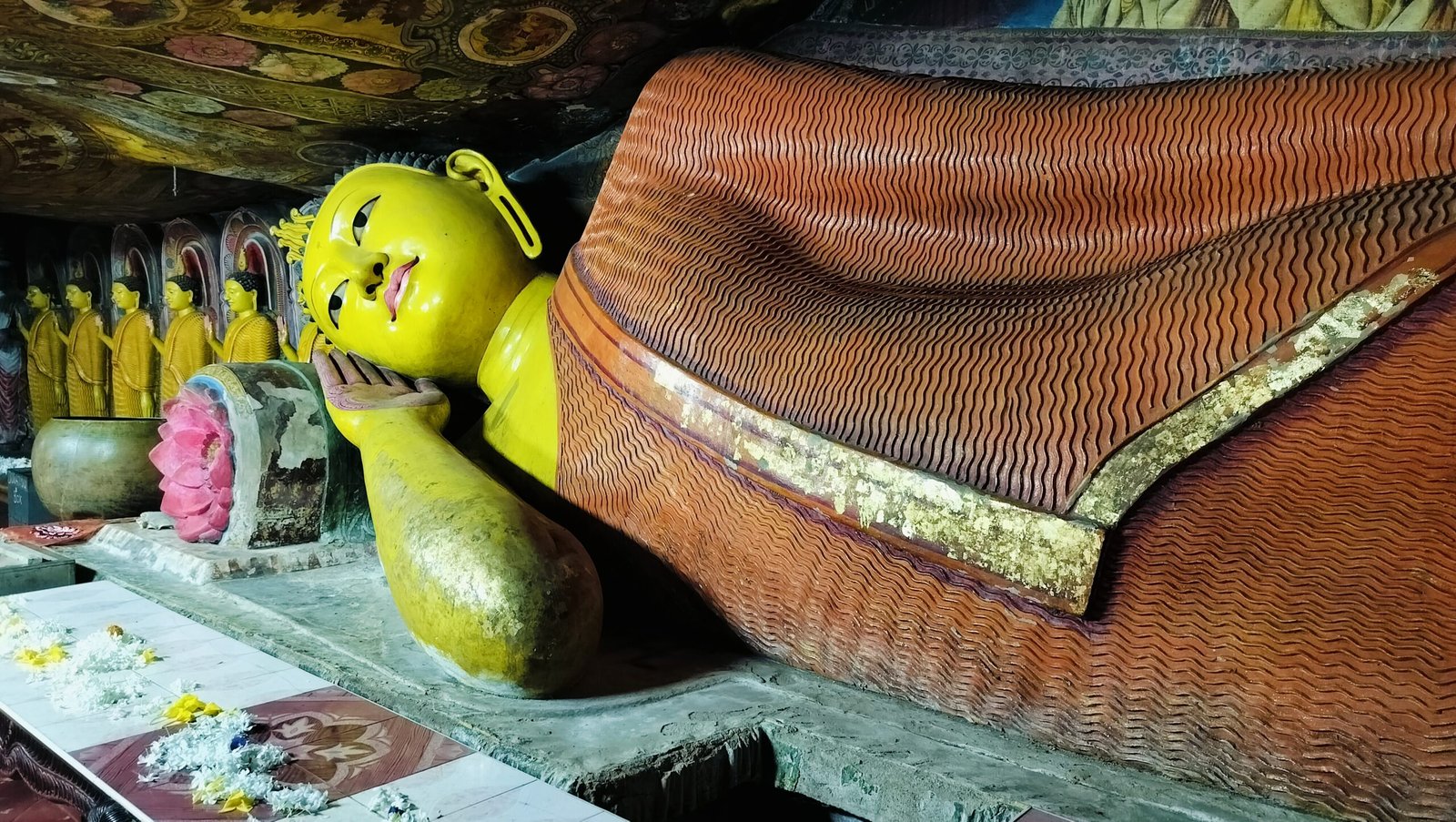
Dambulla Cave Temple gets treated as Sigiriya’s quieter companion stop, and there’s truth to that — most visitors see it the same afternoon they climb Lion Rock. But the Golden Temple of Dambulla, as it’s formally known, is a major site in its own right: five caves carved into a 160-meter granite outcrop, holding more than 150 Buddha statues and ceilings painted in a level of detail that photographs consistently undersell. It’s Sri Lanka’s largest and best-preserved cave temple complex, and it’s been a site of continuous Buddhist worship for over two thousand years.
For the wider region, our Cultural Triangle guide covers how Dambulla fits alongside Sigiriya, Polonnaruwa, and Kandy.
Why Dambulla Belongs on Your Sri Lanka Itinerary
The caves date back to the 1st century BCE, when King Valagamba is said to have taken refuge here during a period of exile, later transforming the site into a temple in gratitude after reclaiming his throne. Successive kings expanded and repainted the caves over the following centuries, which is why the murals inside range from ancient to relatively recent without ever feeling disjointed. UNESCO listed Dambulla as a World Heritage Site in 1991, recognizing it as the best-preserved cave temple complex in the country.
Inside the Five Caves
Each of the five caves has its own character rather than repeating the same setup. The largest, the Cave of the Great King (Maharaja Vihara), holds a 14-meter reclining Buddha carved directly from the rock alongside statues of Sinhalese kings and Hindu deities Vishnu and Saman — a reminder that the site absorbed influences well beyond a single tradition. The Cave of the Divine King (Devaraja Vihara), the oldest of the five, centers on another reclining Buddha said to mark the spot where Valagamba himself once sheltered. Every cave’s ceiling is painted floor to apex — a technique and scale of devotional art that’s rare to see this well preserved anywhere in Asia.

The Golden Temple at the Base
At the foot of the rock, a modern addition — a 30-meter seated golden Buddha statue and museum building, completed in 2000 — gives the complex its popular name and its most photographed exterior shot. It’s worth a quick look, but treat it as a prelude rather than the destination; the real reason to visit is up the rock, inside the caves themselves.

Visitor Tips: What to Know Before You Go
- Dress modestly: shoulders and knees covered is required, not just polite, and it’s enforced at the entrance.
- Shoes come off: before entering any of the caves, so wear something easy to slip on and off, and expect the stone floors to be hot at midday.
- Photography rules vary by cave: flash photography is generally restricted around the older murals to protect the pigments — follow the on-site signage rather than assuming.
- Watch for monkeys: troops of macaques live around the site entrance and are used to visitors; keep food and loose bags zipped.
- The climb up is moderate, not strenuous: a paved, stepped path with handrails and some shade, considerably gentler than Sigiriya’s exposed stairways.
Best Time to Visit Dambulla
Early afternoon works well, particularly if you’re pairing Dambulla with a morning Sigiriya climb — the caves offer welcome shade from the day’s peak heat, and the light inside is more even than the harsh midday glare outside. If Dambulla is a standalone stop rather than a same-day pairing, late morning avoids both the coolest, most crowded early hours and the heat of full afternoon. January to April brings the driest, most comfortable conditions for the walk up.
The Group & Family Travel Angle
- Multi-generational groups: the moderate, shaded climb makes Dambulla one of the easiest major heritage sites in the region for travelers who’d rather skip Sigiriya’s steep stairways.
- Art and history enthusiasts: the sheer density of painted surface across five caves rewards a slower visit than most day-trip itineraries allow — budget 60–90 minutes rather than a quick pass-through.
- Same-day pairing with Sigiriya: Dambulla sits roughly 20 minutes from Sigiriya, making the two a natural morning-then-afternoon combination on a single day.
Practical Travel Logistics
- Getting there: About 3 hours from Colombo by private driver, and roughly 20 minutes from Sigiriya.
- Entrance fee: Priced separately from Sigiriya’s ticket; check the current foreign-visitor rate at the entrance or with your guide, since rates are periodically revised.
- What to wear: Shoulders and knees covered, and shoes you can remove easily before entering the caves.
- Time needed: 60–90 minutes for an unhurried visit through all five caves.
- Best season: January to April for the driest, most comfortable conditions.
Plan It Properly
Dambulla is easy to visit independently, but getting the sequencing right against a Sigiriya climb — and knowing which cave rewards the extra ten minutes — is where local knowledge helps.
Trailwisp’s curated Sri Lanka tour packages already build Dambulla into a well-paced route alongside Sigiriya, Polonnaruwa, and Kandy. Tell us your dates and group size and our local trip designers will handle the rest.
Chat on WhatsApp