Author: Trailwisp team

  • Dambulla Cave Temple Guide: Golden Temple, Frescoes & Visitor Tips

    Dambulla Cave Temple Guide: Golden Temple, Frescoes & Visitor Tips

    Dambulla Cave Temple gets treated as Sigiriya’s quieter companion stop, and there’s truth to that — most visitors see it the same afternoon they climb Lion Rock. But the Golden Temple of Dambulla, as it’s formally known, is a major site in its own right: five caves carved into a 160-meter granite outcrop, holding more than 150 Buddha statues and ceilings painted in a level of detail that photographs consistently undersell. It’s Sri Lanka’s largest and best-preserved cave temple complex, and it’s been a site of continuous Buddhist worship for over two thousand years.

    For the wider region, our Cultural Triangle guide covers how Dambulla fits alongside Sigiriya, Polonnaruwa, and Kandy.

    Why Dambulla Belongs on Your Sri Lanka Itinerary

    The caves date back to the 1st century BCE, when King Valagamba is said to have taken refuge here during a period of exile, later transforming the site into a temple in gratitude after reclaiming his throne. Successive kings expanded and repainted the caves over the following centuries, which is why the murals inside range from ancient to relatively recent without ever feeling disjointed. UNESCO listed Dambulla as a World Heritage Site in 1991, recognizing it as the best-preserved cave temple complex in the country.

    Inside the Five Caves

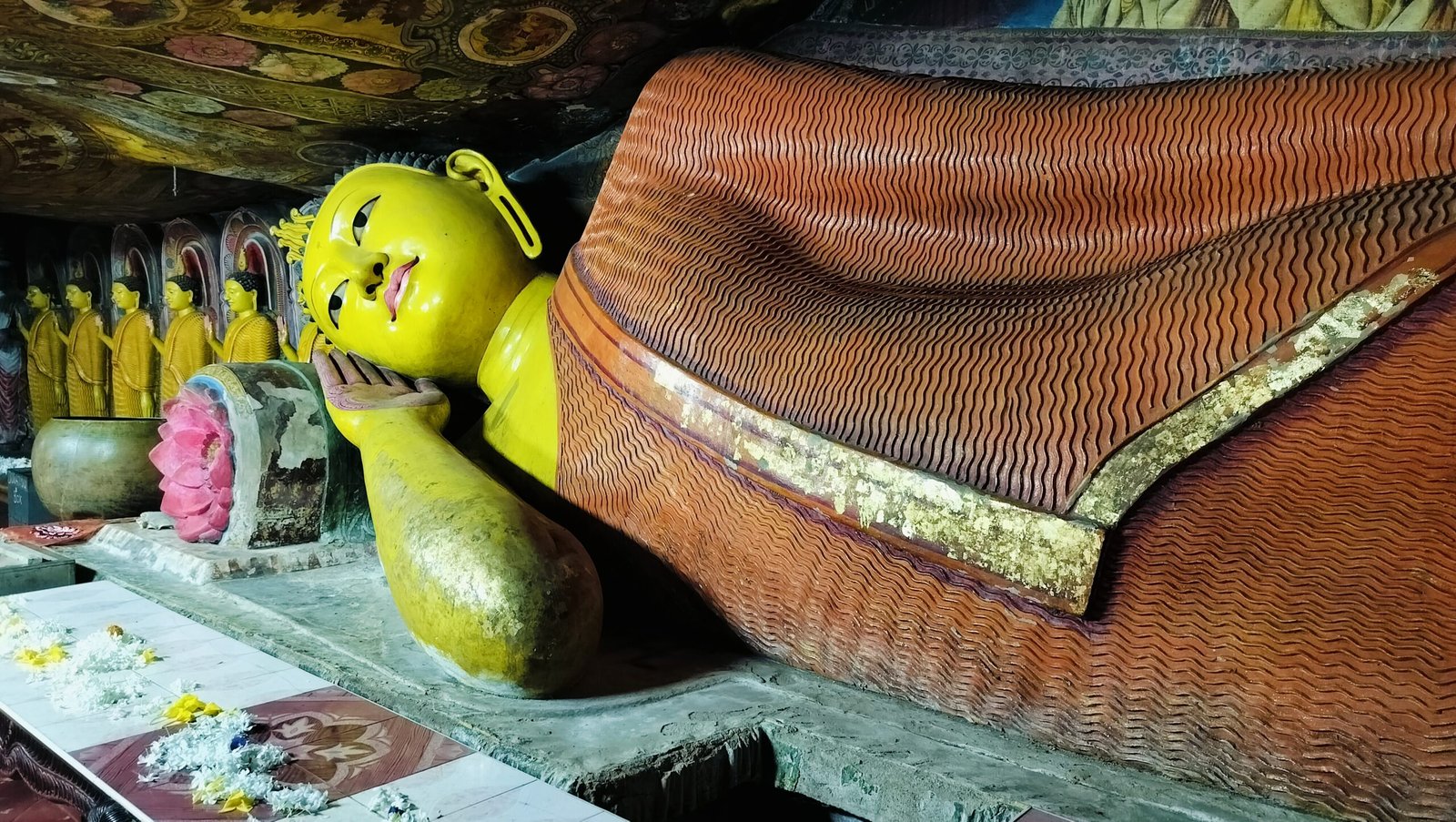
    Each of the five caves has its own character rather than repeating the same setup. The largest, the Cave of the Great King (Maharaja Vihara), holds a 14-meter reclining Buddha carved directly from the rock alongside statues of Sinhalese kings and Hindu deities Vishnu and Saman — a reminder that the site absorbed influences well beyond a single tradition. The Cave of the Divine King (Devaraja Vihara), the oldest of the five, centers on another reclining Buddha said to mark the spot where Valagamba himself once sheltered. Every cave’s ceiling is painted floor to apex — a technique and scale of devotional art that’s rare to see this well preserved anywhere in Asia.

    Large golden reclining Buddha statue beneath painted ceiling murals inside a Dambulla cave, Sri Lanka

    The Golden Temple at the Base

    At the foot of the rock, a modern addition — a 30-meter seated golden Buddha statue and museum building, completed in 2000 — gives the complex its popular name and its most photographed exterior shot. It’s worth a quick look, but treat it as a prelude rather than the destination; the real reason to visit is up the rock, inside the caves themselves.

    Row of golden seated Buddha statues lit against a painted ceiling inside one of Dambulla's caves, Sri Lanka

    Visitor Tips: What to Know Before You Go

    • Dress modestly: shoulders and knees covered is required, not just polite, and it’s enforced at the entrance.
    • Shoes come off: before entering any of the caves, so wear something easy to slip on and off, and expect the stone floors to be hot at midday.
    • Photography rules vary by cave: flash photography is generally restricted around the older murals to protect the pigments — follow the on-site signage rather than assuming.
    • Watch for monkeys: troops of macaques live around the site entrance and are used to visitors; keep food and loose bags zipped.
    • The climb up is moderate, not strenuous: a paved, stepped path with handrails and some shade, considerably gentler than Sigiriya’s exposed stairways.

    Best Time to Visit Dambulla

    Early afternoon works well, particularly if you’re pairing Dambulla with a morning Sigiriya climb — the caves offer welcome shade from the day’s peak heat, and the light inside is more even than the harsh midday glare outside. If Dambulla is a standalone stop rather than a same-day pairing, late morning avoids both the coolest, most crowded early hours and the heat of full afternoon. January to April brings the driest, most comfortable conditions for the walk up.

    The Group & Family Travel Angle

    • Multi-generational groups: the moderate, shaded climb makes Dambulla one of the easiest major heritage sites in the region for travelers who’d rather skip Sigiriya’s steep stairways.
    • Art and history enthusiasts: the sheer density of painted surface across five caves rewards a slower visit than most day-trip itineraries allow — budget 60–90 minutes rather than a quick pass-through.
    • Same-day pairing with Sigiriya: Dambulla sits roughly 20 minutes from Sigiriya, making the two a natural morning-then-afternoon combination on a single day.

    Practical Travel Logistics

    • Getting there: About 3 hours from Colombo by private driver, and roughly 20 minutes from Sigiriya.
    • Entrance fee: Priced separately from Sigiriya’s ticket; check the current foreign-visitor rate at the entrance or with your guide, since rates are periodically revised.
    • What to wear: Shoulders and knees covered, and shoes you can remove easily before entering the caves.
    • Time needed: 60–90 minutes for an unhurried visit through all five caves.
    • Best season: January to April for the driest, most comfortable conditions.

    Plan It Properly

    Dambulla is easy to visit independently, but getting the sequencing right against a Sigiriya climb — and knowing which cave rewards the extra ten minutes — is where local knowledge helps.

    Trailwisp’s curated Sri Lanka tour packages already build Dambulla into a well-paced route alongside Sigiriya, Polonnaruwa, and Kandy. Tell us your dates and group size and our local trip designers will handle the rest.

    Chat on WhatsApp
  • Polonnaruwa Ancient City Guide: Gal Vihara, Things to Do & How to Explore

    Polonnaruwa Ancient City Guide: Gal Vihara, Things to Do & How to Explore

    Polonnaruwa doesn’t get the name recognition Sigiriya does, which is part of why it’s worth the detour. Sri Lanka’s second ancient capital, built up after the fall of Anuradhapura in the 11th century, spreads its ruins — a royal palace, a moated audience hall, brick stupas, and one of the country’s single greatest works of religious art — across flat, walkable, well-shaded parkland. It’s less climbing, more wandering, and it rewards travelers who give it a proper half-day rather than a rushed hour between other stops.

    If Sigiriya is the site everyone photographs and Dambulla is the one everyone climbs into, Polonnaruwa is the one that best rewards actually reading the plaques. For the wider region, our Cultural Triangle guide covers how it fits alongside Sigiriya, Dambulla, and Kandy.

    Why Polonnaruwa Belongs on Your Sri Lanka Itinerary

    After Indian invasions forced the abandonment of Anuradhapura, King Vijayabahu I made Polonnaruwa Sri Lanka’s capital in the 11th century, and his successor, Parakramabahu I, turned it into the island’s golden age of construction — palaces, irrigation reservoirs, and religious monuments built at a scale that still impresses. UNESCO listed the whole ancient city as a World Heritage Site in 1982, and unlike some ruins that require real imagination to appreciate, Polonnaruwa’s structures are intact enough that the scale of the place speaks for itself.

    Curated Highlights: Where to Spend Your Time

    Gal Vihara, the Reason Most People Come

    Four enormous Buddha images — standing, seated, and reclining — carved directly into a single outcrop of granite, Gal Vihara is regarded as one of the finest examples of ancient Sinhalese sculpture anywhere in the country. The 14-meter reclining Buddha in particular is famous for a subtle detail easy to miss on a fast visit: a slight indentation in the pillow beneath the head, carved to suggest actual weight rather than a flat, symbolic figure. Arrive without a tour-bus crowd if you can, and give it fifteen minutes of quiet rather than a five-minute photo stop.

    Close-up profile view of a large seated Buddha statue carved from granite at Gal Vihara, Polonnaruwa

    The Royal Palace and the Council Chamber

    Parakramabahu I’s royal palace once stood seven stories tall; only the brick foundations and lower walls remain, but they’re substantial enough to give a real sense of scale. Nearby, the Council Chamber’s stone-carved elephant frieze and lion-flanked stairway are some of the best-preserved decorative stonework on the site.

    The Vatadage and Rankoth Vehera

    The Vatadage, a circular relic house with concentric stone terraces and seated Buddha statues facing each cardinal direction, is widely considered the finest example of this uniquely Sri Lankan architectural form. A short ride away, Rankoth Vehera — at over 55 meters, the largest stupa built after the Anuradhapura era — is still an active place of worship, not just a ruin.

    Stone entrance stairway flanked by carved guardstones leading into the Vatadage at Polonnaruwa, Sri Lanka

    Parakrama Samudra, the King’s Reservoir

    Parakramabahu I is remembered for a saying attributed to him — that not one drop of rainwater should reach the sea without first serving mankind — and the reservoir bearing his name is the proof. Built as the centerpiece of an irrigation system that still supports local agriculture nearly a thousand years later, it’s worth a sunset stop on the way out of the ancient city, when the water turns gold and the crowds have thinned.

    The Best Way to Explore Polonnaruwa: By Bicycle

    Unlike Sigiriya’s single climb, Polonnaruwa’s ruins are spread across a large, flat, shaded archaeological park — which makes bicycle the standard, and genuinely the best, way to get around. Rental stalls sit near the entrance and museum, and the well-marked network of park roads makes it hard to get meaningfully lost. Plan for two to three hours of unhurried cycling between sites, more if Gal Vihara pulls you in for longer than expected — it usually does. Tuk-tuks and cars work too, but they miss the point of a site built to be experienced slowly, gate to gate, under tree cover.

    Polonnaruwa vs. Anuradhapura: Which Ancient City to Prioritize

    If time only allows one of Sri Lanka’s ancient capitals, the choice usually comes down to this: Anuradhapura is older, larger, and more spread out, with ruins that require more walking (or a longer bike ride) and, in places, more imagination to picture at full scale. Polonnaruwa is more compact, better preserved, and easier to see thoroughly in half a day — which also makes it the more natural pairing with Sigiriya and Dambulla on a Cultural Triangle route, since all three sit within a similar radius. Anuradhapura rewards travelers with an extra day to spare; Polonnaruwa rewards everyone else.

    The Group & Family Travel Angle

    • Families with kids: flat terrain and bicycles make Polonnaruwa far easier on younger legs than Sigiriya’s stairways, without sacrificing the “wow” factor of Gal Vihara’s scale.
    • History-focused travelers: Polonnaruwa’s ruins are dense enough — palace, council chamber, multiple stupas, the Vatadage — to justify a dedicated half-day rather than a drive-through stop.
    • Multi-generational groups: anyone unable to manage Sigiriya’s climb gets an equally significant UNESCO site here with essentially none of the physical demand.

    Practical Travel Logistics

    • Getting there: About 4 hours from Colombo, or roughly 1–1.5 hours from Sigiriya and Dambulla, making it an easy add-on to a Cultural Triangle route rather than a separate trip.
    • Getting around on-site: Bicycle rental at the entrance is the standard approach; allow 2–3 hours minimum.
    • What to wear: Shoulders and knees covered at religious sites, and shoes that slip on and off easily since footwear comes off before entering shrine areas like Gal Vihara.
    • Best time of day: Morning for cooler cycling conditions; late afternoon for Parakrama Samudra at sunset.
    • Best season: January to April for the driest, most comfortable cycling weather.

    Plan It Properly

    Polonnaruwa rewards a properly paced half-day more than almost any other site in the Cultural Triangle — but knowing which ruins to prioritize if time is tight, and how to link it with Sigiriya and Dambulla, is where local planning helps.

    Trailwisp can build Polonnaruwa into a Cultural Triangle route alongside Sigiriya, Dambulla, and Kandy, tailored to your dates and group size. Tell us what you’re picturing and our local trip designers will handle the rest.

    Chat on WhatsApp
  • Sigiriya Rock Fortress Guide: How to Climb Lion Rock, Sri Lanka

    Sigiriya Rock Fortress Guide: How to Climb Lion Rock, Sri Lanka

    Sigiriya isn’t just another item on a Sri Lanka itinerary — it’s the reason many people build the itinerary in the first place. A sheer 200-meter column of rock rising out of flat jungle, topped with the ruins of a 5th-century palace and guarded by a pair of giant carved lion’s paws, Sigiriya (often called Lion Rock) is one of the most photographed sites in the country, and one of the few that lives up to the photos. Climbing it takes a morning. Understanding what you’re actually climbing takes a bit more context, which is what this guide is for.

    This is a practical guide to Sigiriya specifically — the climb, the timing, the ticket, and the Pidurangala question everyone asks once they’ve read a little about it. If you’re planning the wider region, our Cultural Triangle guide covers how Sigiriya, Dambulla, and Kandy fit together into one trip.

    Why Sigiriya Belongs on Every Sri Lanka Itinerary

    The rock’s history is stranger than most ruins get to be. In the 5th century, King Kasyapa built a fortified palace on top of it — reportedly to defend against a brother he’d deposed — complete with water gardens at the base, a boulder garden partway up, and a mirror wall polished smooth enough to reflect the frescoes painted beside it. When the threat passed, the site reverted to a Buddhist monastery, and it sat largely quiet for over a thousand years until 19th-century surveyors rediscovered it under jungle growth. UNESCO listed it as a World Heritage Site in 1982, and it remains one of the best-preserved examples of ancient urban planning in Asia — not just a fortress, but a complete, engineered city.

    What to Expect on the Climb

    The Water Gardens and the Base

    The climb technically starts long before the stairs do. Sigiriya’s symmetrical water gardens at the base still function using the original 5th-century hydraulic system — one of the oldest surviving examples of landscape gardening anywhere in the world. Give yourself ten minutes to walk through them before the ascent; most visitors rush past on the way to the rock and miss it entirely.

    The Mirror Wall and the Frescoes

    Partway up, a sheltered spiral staircase leads to a gallery of frescoes — 1,600-year-old paintings of women, likely court attendants or celestial figures, still holding remarkably vivid color in a protected rock pocket. Just past them, the Mirror Wall was once polished to a shine bright enough to reflect the frescoes back at visitors; it’s now covered in centuries of graffiti-turned-artifact, some of it over a thousand years old and itself protected as historical record. Photography inside the fresco gallery is restricted, so look rather than shoot.

    The Lion’s Paw Gateway

    The final approach to the summit passes between two enormous carved lion’s paws — all that remains of a full lion’s head and body that once formed the entrance, giving the rock its name. From here, the last stretch is steep, exposed steel stairways bolted directly into the rock face, with genuinely no shade. This is the part that decides whether Sigiriya is a pleasant morning or a rough one, which is exactly why timing matters as much as it does.

    The Summit Ruins

    The top isn’t a viewpoint bolted onto a rock — it’s the actual footprint of Kasyapa’s palace: foundations, a throne cut from stone, a former pool that still holds rainwater, and a 360-degree view over jungle, reservoirs, and, on a clear morning, Pidurangala rock to the north. It’s worth sitting with for longer than the ten minutes most tour groups give it.

    Best Time to Visit Sigiriya

    Arrive by 7am, ideally at opening. There’s no shade on the exposed upper stairways, and both the heat and the tour-bus crowds build fast after 9am — by mid-morning, the narrow stairways can bottleneck badly. The round trip takes about two hours at an unhurried pace. Seasonally, January to April offers the driest, clearest conditions for the climb; the wetter months bring a real risk of the upper stairways closing altogether if rock surfaces get slick.

    Sigiriya Entrance Fee & Tickets

    Sigiriya is managed by Sri Lanka’s Central Cultural Fund and is one of the more expensive single-site tickets in the country for foreign visitors, priced well above what locals pay — the gap reflects its upkeep as a UNESCO site rather than any attempt to gouge visitors. Rates change periodically, so check the current foreign-visitor price before you go rather than relying on an old number online. Tickets are sold at the entrance and typically include access to the small on-site museum, which is worth the fifteen minutes it takes to walk through before or after the climb.

    Sigiriya vs. Pidurangala: Which Rock Should You Climb?

    This is the question almost everyone researching Sigiriya ends up asking. Pidurangala is a separate rock a short drive away, cheaper to climb, far less crowded, and — crucially — it’s the spot that gives you the classic postcard view of Sigiriya itself, which you obviously can’t get while standing on top of it. The climb is rougher and less developed than Sigiriya’s engineered stairways, with a rock scramble near the top. If you only have time or energy for one, climb Sigiriya for the history and the summit ruins. If you have a second morning, Pidurangala at sunrise — looking back at Sigiriya lit up gold — is one of the most rewarding half-days in the Cultural Triangle and pairs naturally as a two-rock, two-morning combination.

    The Group & Family Travel Angle

    • Families with kids: the “a king built a fortress on a rock” story, told well, turns 1,200 steps from an endurance test into something children actually stay engaged with — a good local guide makes a bigger difference here than at almost any other site in the region.
    • Multi-generational groups: the exposed upper stairways aren’t for everyone; Dambulla and Polonnaruwa nearby offer equally rich history with far less physical demand for anyone who’d rather sit this climb out.
    • Photography-focused travelers: budget a full morning rather than treating Sigiriya as a quick stop — the water gardens, frescoes, and summit each reward slower attention than a rushed itinerary allows.

    Practical Travel Logistics

    • Getting there: Roughly 3–3.5 hours from Colombo by private driver, and about 20 minutes from Dambulla, making a same-day pairing of the two straightforward.
    • What to bring: Water, a hat, sunscreen, and comfortable closed shoes — the metal stairways get hot and can be slippery in light rain.
    • What to wear: Modest dress isn’t strictly enforced for the climb itself, but shoulders and knees covered is expected near the summit’s monastic remains.
    • Best season: January to April for the driest stairway conditions and clearest summit views.
    • Time needed: About two hours for Sigiriya alone; add an extra hour if you’re pairing it with Pidurangala the same trip.

    Plan It Properly

    Sigiriya is straightforward to visit independently, but getting the timing right — early enough to beat both the heat and the crowds, paced well against Dambulla or Pidurangala the same trip — is where a bit of local planning pays off.

    Trailwisp’s curated Sri Lanka tour packages already build Sigiriya into a well-paced Cultural Triangle route alongside Dambulla and Polonnaruwa. Tell us your dates and group size and our local trip designers will handle the rest.

    Chat on WhatsApp
  • Hiriketiya, Sri Lanka: The South Coast’s Surf Town Guide

    Hiriketiya, Sri Lanka: The South Coast’s Surf Town Guide

    Hiriketiya wasn’t on most Sri Lanka maps a decade ago, and it still isn’t trying that hard to be found — there’s no main street to speak of, just a handful of guesthouses and juice bars strung along a perfectly curved horseshoe bay a few kilometers off the main coastal highway. That’s precisely the appeal. While Mirissa and Weligama have grown into the south coast’s busiest beach towns, Hiriketiya has stayed small on purpose, and travelers who find it tend to stay longer than they planned.

    It works especially well as a slower counterpoint to a busier itinerary — the place you land after a few fast-paced days in the Cultural Triangle or hill country, when what you actually want is a bay small enough to swim across and nothing on the schedule.

    Why Hiriketiya Belongs on a South Coast Itinerary

    The bay’s horseshoe shape does two things most straight beaches can’t: it creates a gentler, more consistent wave that suits learners and longboarders, and it means you can watch the entire beach — surfers, swimmers, sunset — from a single spot without moving. Add the backwater lagoons just inland, largely unexplored by day-trippers, and Hiriketiya offers more range than its small footprint suggests.

    Curated Highlights: Where to Spend Your Time

    Surfing the Horseshoe, Beginners Included

    Hiriketiya’s wave breaks both left and right off a sandy bottom, which makes it considerably more forgiving than the reef breaks found elsewhere on the south coast — a genuine reason it’s become a first-choice spot for people learning to surf in Sri Lanka. Board rental and lesson stalls line the northern end of the bay; mornings before the onshore wind picks up tend to offer the cleanest conditions.

    The Backwaters, Away from the Beach Crowd

    A short tuk-tuk ride inland, palm-fringed backwater lagoons offer a completely different register from the beach — still water, mangroves, and none of the surf crowd. A slow paddle or a quiet boat ride through them in the late afternoon, when the light softens and the water turns glassy, is one of the area’s most underrated hours.

    Palm-fringed backwaters near Hiriketiya on Sri Lanka's south coast

    Dalawella & the Coconut Tree Swing, Early

    A short drive west, Dalawella’s famous rope swing over the beach is one of the most photographed spots on the south coast — and predictably crowded by mid-morning. Go at sunrise instead, when the light is better and you’ll likely have it to yourself, then pair the visit with breakfast at one of the beachfront cafés nearby before the day’s heat sets in.

    Galle Fort, Forty Minutes Away

    Hiriketiya sits close enough to Galle Fort to fold in a half-day trip without disrupting the slow pace that’s the whole point of staying here — ramparts at golden hour, Dutch colonial architecture, and a lighthouse walk that’s more atmosphere than spectacle. Late afternoon into sunset is the better window; the cobblestone streets get uncomfortably hot at midday.

    The Traveler Angle

    • Learner surfers get more consistent, forgiving conditions here than at most other south coast breaks — a genuinely good place to take your first few lessons rather than being intimidated by a reef break.
    • Digital nomads and slow travelers tend to stay far longer than planned — the town has enough café and co-working infrastructure now to support a multi-week stay without feeling isolated.
    • Couples wanting a quiet coastal stop should treat Hiriketiya as the “do nothing” leg of a longer itinerary — it pairs naturally with a faster-paced Cultural Triangle or hill-country stretch earlier in the trip.

    Practical Travel Logistics

    • Getting there: About 2.5–3 hours from Colombo via the Southern Expressway, roughly 20 minutes past Mirissa and Weligama.
    • Best season for surf: November through April, in line with the south coast’s dry season; the biggest, most consistent swells arrive toward the tail end of that window.
    • Getting around locally: The bay itself is walkable; tuk-tuks cover trips to the backwaters, Dalawella, or Galle Fort.
    • What to know: The bay is small and can feel busy at peak times (Dec–Feb) despite its size — book accommodation ahead if a specific guesthouse matters to you.

    Plan It Properly

    Hiriketiya rewards travelers who build in unstructured time rather than a packed sightseeing list — but knowing which stretch of the trip to slow down for, and how it links to the rest of the south coast, is where local planning helps.

    Trailwisp can fold a Hiriketiya stop into any south coast itinerary alongside Mirissa, Weligama, or Galle Fort, tailored to your dates and group size. Tell us what you’re picturing and our local trip designers will handle the rest.

    Chat on WhatsApp
  • Nuwara Eliya Travel Guide: Sri Lanka’s Tea Country, Gregory Lake & Top Things to Do

    Nuwara Eliya Travel Guide: Sri Lanka’s Tea Country, Gregory Lake & Top Things to Do

    Nuwara Eliya is the moment Sri Lanka’s climate flips on you. Come up from Kandy and within two hours the heat drops away, the air smells like wet tea leaf instead of dust, and the light turns thin and silver the way it does at altitude. British colonial planters called it “Little England” for the cool climate and the Tudor-style cottages they built to match, and 1,900 meters up, the nickname still more or less fits — misty mornings, manicured gardens, and hills striped green with tea in every direction.

    It’s a genuinely different Sri Lanka from the coast and the Cultural Triangle, and it rewards travelers who slow down rather than treat it as a scenic drive-through on the way to Ella.

    Why Nuwara Eliya Belongs on Every Sri Lanka Hill Country Itinerary

    Most of Sri Lanka’s famous tea comes from estates within a short drive of Nuwara Eliya, which makes it the obvious base for anyone who wants to see — and taste — where Ceylon tea actually comes from, rather than just buying a box at the airport. It also sits at the highest elevation of any major stop on a typical itinerary, giving it a cooler, calmer register than anywhere else on the route.

    Curated Highlights: Where to Spend Your Time

    A Working Tea Factory, Not Just a Gift Shop

    Several estates around Nuwara Eliya run proper factory tours that walk you through withering, rolling, and firing rather than just steering you to a gift shop at the end. Time it for mid-morning when the factory is actively processing the day’s pluck — watching a leaf go from bush to cup in under two hours changes how you drink tea afterward.

    Waterfall flowing through a tea estate in Sri Lanka's hill country

    Gregory Lake, Slower Than It Looks

    Gregory Lake is Nuwara Eliya’s central gathering point — paddle boats, a lakeside walking path, and views back up toward the surrounding hills. It’s touristy by the town’s quiet standards, but a slow lap in the late afternoon, when the crowds thin and the light goes gold, is worth the hour it takes.

    Boating on Gregory Lake in Nuwara Eliya, Sri Lanka

    Horton Plains & World’s End, for an Early Start

    About an hour from town, Horton Plains National Park’s signature hike leads to World’s End, a sheer escarpment dropping nearly 900 meters with views clear to the south coast on a clear morning — and only a clear morning. Cloud typically rolls in by 10am, so this is a hike you start before sunrise or not at all. The full loop, including the equally striking Baker’s Falls, takes 3–4 hours.

    Colonial Architecture & the Old Racecourse

    The town center still carries its “Little England” nickname visibly — a Tudor-style post office, a golf course, and manicured public gardens that feel transplanted from a different climate entirely. It’s a pleasant, easy walk between the lake and the main street, and a good low-effort way to spend an hour if the weather turns.

    The Group & Family Travel Angle

    • Families tend to enjoy the tea factory tour and Gregory Lake’s paddle boats more than the more strenuous Horton Plains hike — a good split for mixed-age groups is factory and lake together, with the hike reserved for anyone who wants an early-morning add-on.
    • Couples should build in at least one slow, unscheduled afternoon here — Nuwara Eliya’s whole appeal is the pace, and rushing through in half a day undersells it.
    • Photographers should prioritize Horton Plains at first light and the tea estates in soft mid-morning light, when the mist hasn’t fully burned off the valleys yet.

    Practical Travel Logistics

    • Getting there: Roughly 2–2.5 hours from Kandy, or about an hour further from Ella by road.
    • What to pack: A proper layer — nights and early mornings regularly drop to 10–15°C, cold enough to catch travelers coming up from the coast off guard.
    • Best season: January to March for the clearest views at Horton Plains and World’s End; the town stays cool and green nearly year-round.
    • Horton Plains timing: Enter by 6:30–7am if World’s End is the priority — cloud cover typically closes the view by mid-morning.

    Plan It Properly

    The gap between an average Nuwara Eliya stop and a genuinely memorable one usually comes down to timing — which factory to actually book a tour with, and whether Horton Plains is worth the 5am wake-up on your specific dates.

    Trailwisp’s curated Sri Lanka tour packages build Nuwara Eliya into the hill-country leg of every multi-day route. Tell us your dates and group size and our local trip designers will handle the rest.

    Chat on WhatsApp
  • Kandy Travel Guide: Temple of the Tooth, Things to Do & Where to Stay

    Kandy Travel Guide: Temple of the Tooth, Things to Do & Where to Stay

    Kandy doesn’t try to compete with Sigiriya’s drama or Ella’s views. Its case is quieter and, for a lot of travelers, more lasting: this is the city where Sri Lanka’s spiritual life is still visibly, audibly happening, not preserved behind glass. Evening drums roll out from the Temple of the Sacred Tooth Relic most nights, monks in saffron robes cross the lake road on foot, and the whole city organizes itself around a single relic in a way few places anywhere still do.

    It’s also the hinge point of most Sri Lanka itineraries — sitting roughly between the Cultural Triangle, the hill country, and the coast — which means almost everyone passes through, but relatively few spend more than a rushed afternoon here. That’s a mistake this guide is meant to fix.

    Why Kandy Belongs on Every Sri Lanka Itinerary

    Kandy is Sri Lanka’s second city and its last royal capital, and it carries both roles visibly — a lake built by the last king, a temple that still functions as a living religious site rather than a museum piece, and a hill-ringed setting that makes it feel calmer than its size suggests. It’s also the natural link between the Cultural Triangle and the tea country further up in elevation, which is exactly why almost every multi-region Sri Lanka itinerary routes through it.

    Curated Highlights: Where to Spend Your Time

    The Temple of the Sacred Tooth Relic, at the Right Hour

    The temple houses what’s believed to be a tooth relic of the Buddha, and it functions less like a tourist stop and more like the city’s actual center of gravity. A quiet midday visit shows you the architecture; the evening puja ceremony (roughly 6:30–8pm) shows you why the relic still matters as much as it does — drums, devotees, and an atmosphere no daytime visit replicates. If you only have one window, take the evening one.

    Aluvihare Rock Temple, the Overlooked Half-Day Trip

    About 30 minutes north of Kandy toward Matale, Aluvihare Rock Temple is where the Pali Canon — the earliest written record of the Buddha’s teachings — was first committed to writing, inside a cluster of cave shrines built into a granite outcrop. It sees a fraction of the visitors that the Temple of the Sacred Tooth Relic does, which makes it one of the better quiet counterpoints on a Kandy day — the same depth of history, without the crowds.

    Aluvihare Rock Temple, an ancient cave shrine near Matale in Sri Lanka's Cultural Triangle

    Kandy Lake & a Walk Around the City Center

    The lake King Sri Wickrama Rajasinghe built in 1807 still anchors the city center, and a slow lap of it in the late afternoon — monitor lizards on the banks, monks crossing toward the temple, the hills rising behind the rooftops — is one of the more underrated free things to do in Sri Lanka. Pair it with the Kandy Garrison Cemetery or the Royal Botanical Gardens at Peradeniya, a 20-minute drive out, if you have a spare afternoon.

    The Esala Perahera, If Your Dates Align

    Once a year — usually late July or August — Kandy holds the Esala Perahera, a ten-night procession of illuminated elephants, fire dancers, and drummers honoring the Sacred Tooth Relic, widely considered one of Asia’s most spectacular religious festivals. Accommodation books out well ahead for the final nights, so this is one to plan around deliberately rather than hope to catch by chance.

    Where to Stay in Kandy

    Lakeside hotels put you within walking distance of the temple and the evening puja, which matters more here than in most towns — you won’t want to be relying on a tuk-tuk after dark on procession nights. For a quieter stay, hillside properties just outside the center trade a five-minute walk for a proper view over the lake and rooftops.

    The Group & Family Travel Angle

    • Multi-generational trips find Kandy easy to manage — the temple, lake walk, and botanical gardens ask little physically, unlike the Sigiriya climb or a hill-country trek.
    • Couples and honeymooners should prioritize the evening puja and a lakeside dinner — Kandy’s after-dark atmosphere, drums carrying across the water, is one of the more romantic overlooked moments on a Sri Lanka itinerary.
    • Groups touring the Cultural Triangle naturally use Kandy as the hinge point between Sigiriya/Dambulla and the hill country — a one-night stay works, but two lets you fit in Aluvihare or Peradeniya without rushing.

    Practical Travel Logistics

    • Getting there: About 3 hours from Colombo by private driver; roughly 1.5–2 hours from Sigiriya/Dambulla.
    • Onward to hill country: Nuwara Eliya is roughly 2–2.5 hours further, climbing through tea estates.
    • What to wear: Shoulders and knees covered at the temple; shoes come off before entering, so wear something easy to slip on and off.
    • Best time of day: Evening for the temple puja, late afternoon for the lake walk, morning for Aluvihare or Peradeniya before the heat sets in.

    Plan It Properly

    Kandy rewards a bit of local knowledge — which evening the puja is most atmospheric, whether Aluvihare is worth the detour on your specific dates, and how to sequence it against the rest of a Cultural Triangle or hill-country route.

    Trailwisp’s curated Sri Lanka tour packages already build Kandy into a well-paced route alongside Sigiriya, Dambulla, and the hill country. Tell us your dates and group size and our local trip designers will handle the rest.

    Chat on WhatsApp
  • Best Time to Visit Sri Lanka: A Month-by-Month Weather & Travel Guide

    Best Time to Visit Sri Lanka: A Month-by-Month Weather & Travel Guide

    “When’s the best time to visit Sri Lanka?” is one of the most common questions we get, and it’s also one of the few where the honest answer is “it depends where you’re going” rather than a single tidy month. Sri Lanka sits under two separate monsoon systems that hit opposite coasts at different times of year, which means the west and south coasts can be in glorious dry season while the east coast is getting soaked — and vice versa six months later. Get the region-to-month pairing right, and you can visit comfortably almost any time of year.

    Here’s how to actually read the calendar, region by region, rather than relying on a single blanket recommendation that only works for half the island.

    Sri Lanka’s Two Monsoons, in Plain English

    The Yala monsoon brings rain to the south and west coasts (and hill country) roughly May through September. The Maha monsoon flips the pattern, bringing rain to the north and east coast roughly October through January. Because most first-time visitors build their trip around the south coast, hill country, and Cultural Triangle — all in the western half of the “wet” zone for the Maha monsoon — the widely quoted “best time” of December through March genuinely does hold up for the classic itinerary. But it’s not the whole story.

    Month-by-Month, by Region

    December to March: Peak Season for the South, West & Hill Country

    This is the driest, clearest stretch for Colombo, the south coast beaches (Bentota, Mirissa, Galle), and the hill country (Kandy, Nuwara Eliya, Ella). It’s also peak season, which means the best hotels and the most scenic small properties book out well in advance — especially over the December–January holiday window, which many curated tours (including ours) exclude from standard pricing. Expect warm, dry days on the coast and cool, crisp mornings in the hills.

    April to September: Shoulder Season in the West, Peak Season on the East Coast

    As the Yala monsoon settles over the south and west, the east coast — Trincomalee, Arugam Bay — comes into its own dry season. If a beach trip is the priority and your dates fall in this window, shifting the itinerary east rather than west is the better move than forcing a south-coast trip into rainier months. This period is also when Yala National Park hits its most reliable wildlife viewing (February through July, with the park closing for annual maintenance for roughly a month each September), since dry conditions concentrate animals around shrinking water sources.

    October & November: The Inter-Monsoon Wildcard

    These two months sit between the monsoons and are genuinely unpredictable — short, heavy afternoon downpours are common across most of the island, but mornings are often clear and the rain rarely lasts all day. It’s shoulder season pricing with a real chance of good weather, which makes it a reasonable bet for flexible travelers who don’t mind adjusting the day’s plan around a passing shower.

    Best Time for Specific Experiences

    • Whale watching off Mirissa: November through April, with December to March considered peak — calmer seas and more consistent sightings.
    • The Kandy Esala Perahera festival: a ten-night procession usually held in late July or August, tied to the lunar calendar — worth building an entire trip’s timing around if your dates have flexibility.
    • Hiking Adam’s Peak (Sri Pada): the pilgrimage season runs December through May, when trail conditions are safest and the summit sunrise view is least likely to be obscured by cloud.
    • Surfing at Weligama or Hiriketiya: the south coast’s surf season broadly follows its dry season, November through April, with the biggest swells arriving toward the tail end.

    Choosing Dates for Your Trip Type

    • First-time visitors doing the classic hill-country-and-south-coast route should aim for December through March and book accommodation early — this is genuinely the best window, and everyone else knows it too.
    • Budget-conscious travelers willing to trade a few afternoon showers for lower prices should look at April, September, or November — shoulder season rates with generally manageable weather.
    • Wildlife-focused trips built around Yala should prioritize February through July over the classic peak season, since that’s when the park itself performs best, regardless of coastal weather elsewhere.
    • East coast beach trips (Trincomalee, Arugam Bay) should flip the usual advice entirely and aim for May through September, when the west coast is at its wettest.

    Practical Travel Logistics

    • Temperature: The coast and lowlands stay warm year-round (28–32°C); hill country towns like Nuwara Eliya run noticeably cooler, often 15–20°C, especially at night — pack a layer even in “dry season.”
    • Booking lead time: Peak season (Dec–Mar) hotels and small boutique properties should be booked 2–3 months ahead; shoulder season allows much more last-minute flexibility.
    • Rain during peak season: Even in the driest months, brief afternoon showers happen — they rarely disrupt a full day’s plans.

    Plan It Properly

    The single biggest mistake we see is travelers applying the “December to March” rule to the entire island, then either overpaying for peak-season rates on a trip that didn’t need them, or missing the east coast’s actual dry season entirely. Which month is genuinely best depends on which regions are on your route.

    Tell Trailwisp’s local trip designers your travel dates and we’ll build (or adjust) your itinerary around the regions that will actually have the best weather when you’re there — rather than forcing a fixed route onto the wrong season.

    Chat on WhatsApp
  • How Many Days Do You Need in Sri Lanka? A 4, 5 & 6-Day Itinerary Comparison

    How Many Days Do You Need in Sri Lanka? A 4, 5 & 6-Day Itinerary Comparison

    It’s the question almost every Sri Lanka trip starts with, and almost nobody answers well: how many days do you actually need? Too many generic guides dodge it with “as long as possible,” which is true and also useless when you’re staring at a calendar trying to book flights. The honest answer is that Sri Lanka compresses an unusual amount of range — hill country, coast, ancient cities, wildlife — into a small island, which means the right trip length depends less on the country and more on how many of those worlds you’re trying to fit in.

    Below are three real itinerary lengths, each built around what actually works logistically — not a theoretical best case, but routes people genuinely run without spending half the trip in the car.

    The Real Trade-Off: Depth vs. Breadth

    Sri Lanka is small on a map and slow in a car — mountain roads and single-lane coastal highways mean average speeds rarely top 40–50 km/h once you’re off the main expressways. That single fact should drive your itinerary length more than anything else. A 4-day trip needs a tight, single-region loop. A 6-day trip can string two or three regions together without feeling rushed. Anything shorter than 4 days genuinely isn’t worth the flight; anything longer than 10 starts rewarding you more for slowing down in fewer places than for adding new ones.

    4 Days: The Fast-Paced Long Weekend

    Four days is enough for one tight, well-sequenced loop through the Cultural Triangle and hill country — Sigiriya Rock Fortress, Dambulla’s cave temples, and Kandy’s Temple of the Sacred Tooth Relic, arriving and departing via Colombo. It’s a real trip, not a teaser, but it only works if you commit to one region rather than trying to also squeeze in the coast. Trailwisp’s Serene Sri Lanka Journey (3 nights, 4 days) runs exactly this route.

    Best for: a long weekend add-on to a business trip, a stopover between other Asia destinations, or a first taste of Sri Lanka before a longer trip later.

    5 Days: The Balanced Middle Ground

    Five days opens up a second region without feeling like a scramble. A typical route adds Nuwara Eliya’s tea country and a day trip to Galle Fort onto the Kandy loop, closing in Bentota or Colombo — hill country in the morning cool, coast for the final unwind. Trailwisp’s 05 Days of Serenity (4 nights, 5 days) is built around this exact balance.

    Best for: first-time visitors who want a genuine sample of hill country and coast without a punishing pace, or couples looking for a mid-length trip that still leaves a full day to just sit still.

    Nine Arch Bridge in Ella, Sri Lanka, surrounded by lush jungle

    6 Days: The Full Arc

    Six days is where Sri Lanka starts to feel complete rather than sampled. This length comfortably links Kandy, Nuwara Eliya’s hill country, Bentota’s beaches, and a proper half-day in Galle Fort, closing with a final night out in Colombo — hill country, coast, heritage, and city in one connected loop with no backtracking. Trailwisp’s Exploration & Tranquility (5 nights, 6 days) covers this full route.

    Best for: honeymoons, anniversary trips, and anyone who wants to leave feeling like they actually saw the island rather than a highlight reel of it.

    What About 10 Days or Longer?

    Past six days, the smart move isn’t cramming in more driving — it’s adding one more distinct region and slowing down everywhere else. A common extension pairs the 6-day hill-country-and-coast loop with a Yala safari or extra nights on the south coast around Mirissa, which sits close enough to the same route to fold in without a major detour. Beyond about 12 days, most repeat visitors stop adding new regions altogether and just return to their favorite one for longer.

    Which Length Fits Your Trip

    • First-time visitors with limited time should default to 5 or 6 days — long enough to avoid a rushed, single-region trip, short enough to stay affordable and easy to plan around a single week of leave.
    • Honeymooners and anniversary trips tend to get more out of 6+ days with fewer stops rather than more — two or three nights each in hill country and on the coast beats a fast tour through five towns.
    • Business travelers extending a trip are the classic 4-day case — the Cultural Triangle loop delivers a complete, memorable trip without needing extra vacation days.
    • Families with kids generally do better stretching a 5-day route to 6 or 7 — the extra slack absorbs the inevitable slow mornings and shorter attention spans without cutting a site visit short.

    Practical Travel Logistics

    • Colombo to Kandy: roughly 3 hours by private driver.
    • Kandy to Nuwara Eliya: roughly 2–2.5 hours, climbing through tea country.
    • Nuwara Eliya to Bentota/the south coast: roughly 4–5 hours — this is the longest single transfer in most itineraries, which is why 4-day trips skip it entirely.
    • Bentota to Galle Fort: under an hour, an easy half-day add-on.
    • Bentota/Galle to Colombo: roughly 1.5–2 hours via the Southern Expressway.

    Plan It Properly

    The honest truth is that any of these lengths can be a great trip or a rushed one — the difference is almost entirely in the sequencing, not the number of days. A 4-day trip planned by someone who knows exactly how long the Sigiriya climb really takes will beat a poorly paced 7-day trip every time.

    Trailwisp’s curated Sri Lanka tour packages come pre-built at 4, 5, and 6 days, or our local trip designers can adjust any of them to your exact dates and group size — extending, shortening, or swapping in an extra region like Yala or the south coast.

    Chat on WhatsApp
  • Sri Lanka’s Cultural Triangle: Sigiriya, Dambulla & Kandy Guide

    Sri Lanka’s Cultural Triangle: Sigiriya, Dambulla & Kandy Guide

    Sri Lanka’s Cultural Triangle earns its name honestly — Sigiriya, Dambulla, and Kandy sit close enough together that most itineraries link all three in two or three days, but each one rewards a completely different kind of attention. Sigiriya is about the climb and the view from the top. Dambulla is about slowing down inside a cave full of painted ceilings. Kandy is about a single relic that still shapes how an entire city moves through its year. Treat them as one rushed checklist and you’ll remember none of them clearly. Give each its own morning or afternoon, and they stack into one of the most complete cultural experiences on the island.

    This is also the part of Sri Lanka where the history stops being background scenery and starts being the actual point of the trip — which changes how you should plan around it, from what time you show up to how long you give yourself at each site.

    Why the Cultural Triangle Belongs on Every Sri Lanka Itinerary

    This corner of the island holds most of Sri Lanka’s UNESCO World Heritage sites within a couple of hours’ drive of each other — a rare concentration that lets you go deep on history without the long transfers that heritage-focused trips usually demand elsewhere. It’s also the natural first or last stop on a longer itinerary, sitting roughly between Colombo and the hill country.

    Curated Highlights: Where to Spend Your Time

    Sigiriya Rock Fortress, Timed Right

    The climb up Sigiriya — roughly 1,200 steps past the famous frescoes and through the lion’s-paw gateway to the summit ruins — takes about two hours round trip at an unhurried pace. Start by 7am. The steel stairways up the rock face have almost no shade, and by mid-morning both the heat and the tour-bus crowds make the ascent considerably less pleasant. The summit view over the surrounding jungle and reservoirs is the payoff, and it’s worth sitting with for longer than most visitors do before heading back down. For ticket prices, timing, and the Pidurangala alternative, see our full Sigiriya guide.

    Dambulla Cave Temple, the Quieter Companion Stop

    Twenty minutes from Sigiriya, Dambulla’s five cave temples hold over 150 Buddha statues and ceilings painted in detail that’s easy to underestimate from photos alone. It pairs naturally with Sigiriya as a same-day stop — do Sigiriya in the cool of the morning, then Dambulla in the early afternoon, when the caves offer welcome shade from the heat outside. Modest dress is required (shoulders and knees covered) and shoes come off before entering, so plan for that at the entrance. For a full breakdown of all five caves, see our Dambulla guide.

    Kandy’s Temple of the Sacred Tooth Relic

    The Temple of the Sacred Tooth Relic houses what’s believed to be a tooth relic of the Buddha, and it functions less like a tourist site and more like the spiritual center of the city — expect to see as many local devotees as visitors, particularly during the evening puja ceremonies (roughly 6:30–8pm), when the temple is at its most atmospheric. Arrive for a ceremony rather than a quiet midday visit if you want to understand why this single relic matters as much as it does here.

    Decorated elephant before the illuminated Temple of the Sacred Tooth Relic during the Kandy Esala Perahera

    The Esala Perahera, If Your Dates Align

    Once a year — usually late July or August, tied to the lunar calendar — Kandy holds the Esala Perahera, a ten-night procession of illuminated elephants, fire dancers, and drummers honoring the Sacred Tooth Relic. It’s widely considered one of Asia’s most spectacular religious festivals, and it’s worth building an entire trip’s timing around if your dates have any flexibility. Accommodation books out well in advance for the final nights, so this is one to plan early rather than hope to catch on a whim.

    The Group & Family Travel Angle

    The Cultural Triangle’s compact geography and mix of physical and low-key sites make it one of the easier regions to plan for a mixed group.

    • Multi-generational trips can split the Sigiriya climb as optional — those who’d rather skip 1,200 steps in the heat have Dambulla and Kandy as equally rich, far less strenuous alternatives nearby.
    • School-age family trips tend to respond best to Sigiriya’s story — a king who built a fortress on top of a rock — told well by a local guide, which turns the climb from an endurance test into something kids actually engage with.
    • Small group and corporate off-site add-ons work well here as a half-day cultural stop bolted onto a hill-country retreat, since Kandy sits roughly midway between the coast and Nuwara Eliya.

    Practical Travel Logistics

    • Getting there: Sigiriya and Dambulla are roughly 3–3.5 hours from Colombo by private driver; Kandy is about 3 hours from Colombo and roughly 1.5 hours further from Sigiriya, making the natural route Colombo → Sigiriya/Dambulla → Kandy rather than backtracking.
    • Best time of day: Early morning for Sigiriya (before 8am), early afternoon for Dambulla, and evening for the Temple of the Sacred Tooth Relic — the sequence works well as a single loop if you’re moving through the region over two days.
    • What to wear: Shoulders and knees covered at all three sites; comfortable closed shoes for the Sigiriya climb, easy to slip off for Dambulla and the Kandy temple.
    • Best season: January to April offers the driest conditions for the Sigiriya climb; if the Esala Perahera is a priority, plan around its dates first and build the rest of the trip around that window.

    Plan It Properly

    The Cultural Triangle is forgiving to visit independently, but the sequencing — what time you arrive at each site, whether your dates catch the Perahera, how the drive links to the rest of your trip — is where local knowledge actually pays off.

    Trailwisp’s curated Sri Lanka tour packages already build Sigiriya, Dambulla, and Kandy into a well-paced route alongside the hill country and coast. Tell us your dates and group size and our local trip designers will handle the rest.

    Chat on WhatsApp
  • Mirissa & Sri Lanka’s South Coast: Beaches, Whale Watching & Galle Fort Guide

    Mirissa & Sri Lanka’s South Coast: Beaches, Whale Watching & Galle Fort Guide

    The south coast is where a lot of Sri Lanka itineraries quietly fall apart — not because there’s nothing to do, but because there’s too much crammed into too small a stretch of coastline, and most visitors try to see all of it in a day. Mirissa, Weligama, and the beaches either side of them run for barely twenty kilometers, but that short run holds one of the most reliable blue whale populations on the planet, a Dutch colonial fort you could spend a full afternoon in, and enough curved-bay beach to justify doing nothing at all for a few days. The trick isn’t finding things to do here. It’s not rushing them.

    This stretch works differently depending on why you’re here — a honeymoon slows down and stays in one place, a family trip splits time between the beach and a couple of easy outings, and a quick add-on to a longer itinerary needs to know exactly what to prioritize in 48 hours. Here’s how to make that call.

    Why Mirissa Belongs on Every Sri Lanka Beach Itinerary

    Most of Sri Lanka’s south coast shares the same warm water and palm-lined sand, but Mirissa’s specific advantage is what sits just offshore: a drop-off close to land where blue whales — the largest animals to have ever lived — feed for much of the year. Pair that with Weligama’s beginner-friendly surf next door and Galle Fort forty minutes west, and you get a base with more range than any single beach town on the island.

    Curated Highlights: Where to Spend Your Time

    Whale Watching, Done at the Right Time of Year

    Boats leave Mirissa harbour around 6:30am, and that early departure matters — the sea is calmer and whales are more active before the wind picks up later in the morning. The season runs roughly November through April, with December to March considered peak. Book a smaller boat over a large tour vessel if you can; fewer passengers means less time waiting for a turn at the rail when something surfaces.

    Whale watching off Mirissa, Sri Lanka's south coast

    Coconut Tree Hill, Before the Crowds

    The palm-covered headland between Mirissa and Weligama is one of the most photographed spots in Sri Lanka, which means by mid-morning it’s full of tripods and drone operators waiting their turn. Go at sunrise instead — the light is better, the coconut palms are still in silhouette against the water, and you’ll likely have the whole viewpoint to yourself for a good twenty minutes.

    A Half-Day in Galle Fort

    Galle Fort rewards slow wandering more than a checklist — the ramparts at golden hour, the mix of Dutch colonial architecture and independent boutiques along the old streets, and a lighthouse that’s more atmosphere than spectacle but worth the walk regardless. Aim for late afternoon into sunset; the heat of midday makes the cobblestone streets far less pleasant than the same walk two hours later.

    Rocky Sri Lankan coastline silhouetted at sunset

    Which Beach Town Actually Fits You

    Mirissa suits travelers who want a proper beach base with restaurants and boat trips on the doorstep. Weligama, ten minutes east, is the better pick if you’re learning to surf — the bay’s gentle break is built for beginners. Tangalle, further along the coast, trades convenience for quiet: fewer restaurants, longer stretches of empty sand, and a slower pace that suits a multi-night stay over a quick stop.

    The Group & Occasion Travel Angle

    The south coast’s mix of easy logistics and genuine range — wildlife, culture, and straightforward beach time all within an hour of each other — makes it work for a wider range of trips than most single-purpose beach destinations.

    • Honeymoons tend to do best based in one property for three or more nights rather than moving around — a beachfront villa with a private stretch of sand does more for the trip than an extra town ticked off.
    • Family trips split naturally between the beach in the mornings, when the sun is manageable, and an outing — Galle Fort or whale watching — in the afternoon or on alternating days.
    • Friend groups and milestone trips get the most out of Mirissa specifically, where the restaurant and bar scene along the beach road gives a group something to do together after dark that a quieter town like Tangalle doesn’t offer.

    Practical Travel Logistics

    • Getting there: About 2.5–3 hours from Colombo via the Southern Expressway; a private driver is far more comfortable than the coastal train for this route despite the train’s scenic reputation further south toward Galle.
    • Best season: December to March for the clearest skies and calmest whale-watching seas; the coast stays warm and swimmable most of the year, but rougher seas from May to September can cancel boat trips.
    • Getting around locally: Tuk-tuks cover short hops between Mirissa, Weligama, and nearby viewpoints; a hired driver for the day makes sense for the Galle Fort trip.
    • Booking ahead: Whale-watching boats fill up in peak season (Dec–Mar) — book at least a day or two in advance rather than showing up at the harbour that morning.

    Plan It Properly

    The south coast is forgiving to travel loosely, but the difference between a good trip and a great one still comes down to details a generic guide won’t have — which boat operator to actually book with, which week the whales are most reliable, and how to sequence Galle Fort so you’re not fighting the midday heat.

    Trailwisp’s curated Sri Lanka tour packages already build the south coast in alongside hill country and cultural stops, or we’ll shape a beach-only itinerary around your dates. Tell us what you’re picturing and our local trip designers handle the rest.

    Chat on WhatsApp